
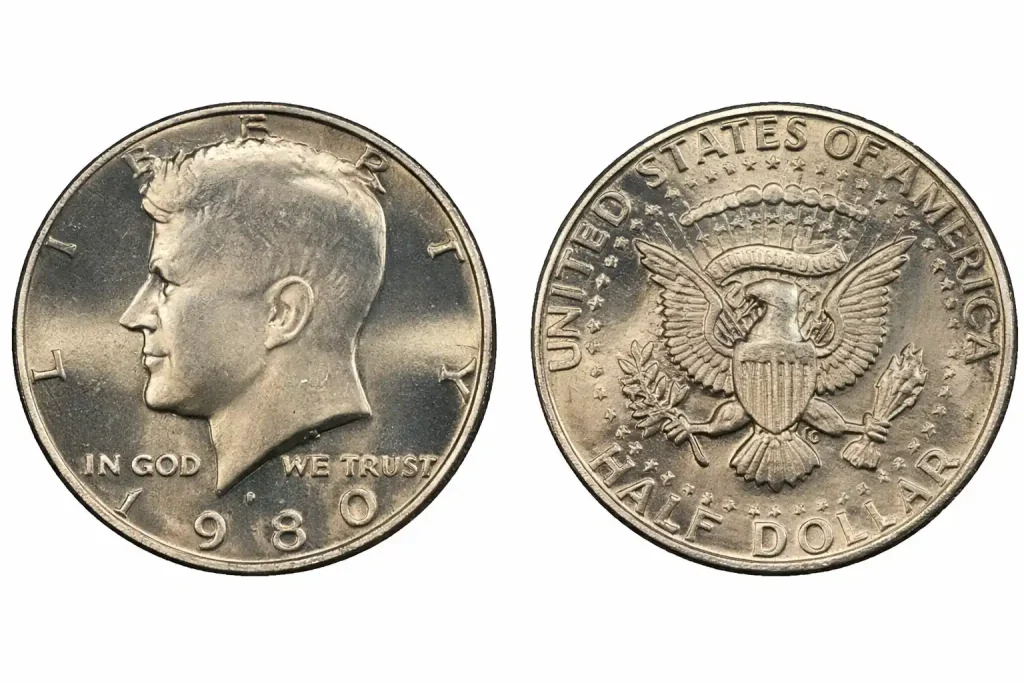

The 1980 50 cent coin value looks simple at first. Most pieces are common. Most are inexpensive.
To get an instant answer about the coin’s value, try a coin scanner app free of charge and then move on. That first impression is only half right. The 1980 Kennedy half dollar is a common date. The market still becomes selective when grade, surfaces, and format improve. That is the real story of this coin.
The 1980 Kennedy Half Dollar in Context
The 1980 half dollar belongs to the long-running Kennedy series. It is a clad coin, not a silver issue. By 1980, the denomination was still a regular Mint product, but it played a much smaller role in daily commerce than cents, nickels, dimes, or quarters. That matters. It helps explain why the coin is easy to find in sets and dealer stock, but not always common in pocket change.
This date also sits in a practical part of the series. It is not a key date. It is not a novelty issue. It is not saved for metal content. Most collectors meet it in one of three ways: a date-and-mint set, a proof set, or a quick search through modern half dollars. That keeps the base market quiet. It also keeps attention on quality rather than hype.
Types of 1980 Kennedy Half Dollars
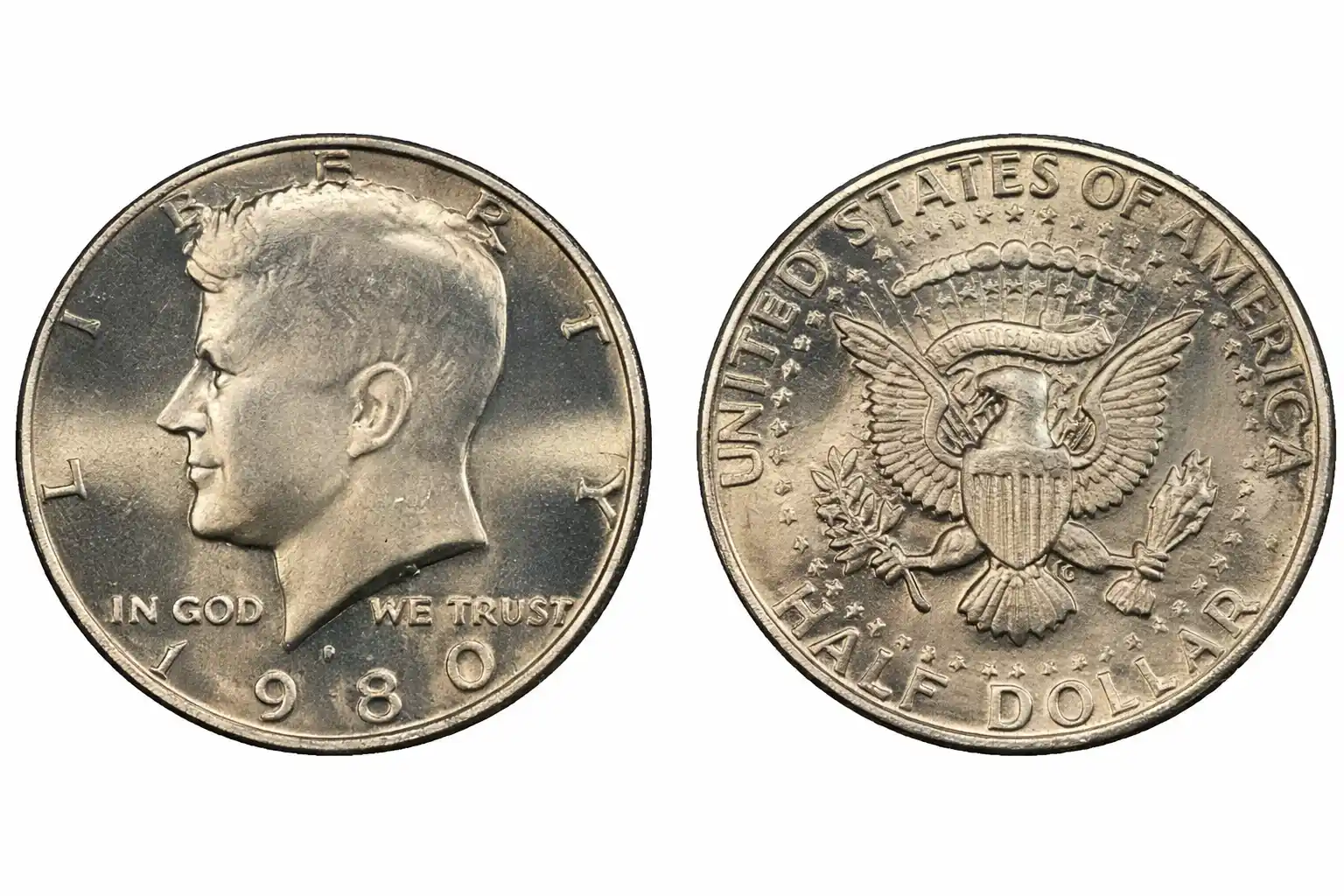
Before discussing value, the versions must be separated. The 1980 issue exists in three main forms.
| Type | Mint mark | Format | Main collector role |
| 1980-P | P | Business strike | circulation issue, set coin |
| 1980-D | D | Business strike | circulation issue, set coin |
| 1980-S | S | Proof | collector issue |
The type split is basic, but important. The P and D coins belong in one market discussion. The proof belongs in another. Mixing them creates bad comparisons. A business strike can be common and still become scarce in top grade. A proof can have a lower mintage and still remain affordable because so many were saved from the start.
Design, Composition, and Core Specifications
The 1980 Kennedy half dollar keeps the standard modern design for the series. Gilroy Roberts designed the obverse. Frank Gasparro designed the reverse. The coin uses the regular clad format of the period. It has no silver content in the standard 1980 production.
| Parameter | 1980 Kennedy half dollar |
| Composition | 75% copper, 25% nickel over a pure copper center |
| Weight | 11.30 grams |
| Diameter | 30.61 millimeters |
| Edge | 150 reeds |
| Obverse designer | Gilroy Roberts |
| Reverse designer | Frank Gasparro |
These numbers matter because they define the normal coin. They are also useful when a collector checks an altered piece, a possible wrong planchet claim, or a coin that looks suspiciously light, bright, or off-metal.
Why the Coin Looks Common
The date looks ordinary because, in most cases, it is ordinary. The mintages are large. The coin has no silver. There is no famous date-level rarity attached to it. Circulated examples usually trade close to face-value logic. Lower Mint State coins are easy enough to locate. Many collectors buy them only as fillers.
That first impression is fair, but incomplete. Common date does not mean flat market. It only means the lower end is easy. Once collectors start asking for cleaner surfaces, stronger luster, and better certified grades, the market stops treating every 1980 half the same way. That is where the date becomes more selective than it first appears.
The First Philadelphia Mintmark
The 1980-P has one detail that gives it extra identity in the series. It was the first Kennedy half dollar from Philadelphia to carry the “P” mint mark. That does not make it rare. It does make it easier to remember and slightly more interesting to series collectors than a random modern common date.
This is a good example of a coin that gains attention without becoming a rarity. The first P mintmark adds context. It does not add an automatic premium. The market still judges the coin by condition first.
Mintage and Supply
The mintages explain most of the low-end price structure.
| Type | Approximate mintage |
| 1980-P | 44,134,000 |
| 1980-D | 33,456,449 |
| 1980-S Proof | 3,554,806 |
The P and D business strikes were produced in the tens of millions. The proof had a much smaller total, but it was made for collectors and preserved in large numbers. That keeps the supply of nice proof coins strong. High production for circulation and high survival for proofs work in the same direction: they limit automatic premiums.
Condition as the Real Divider
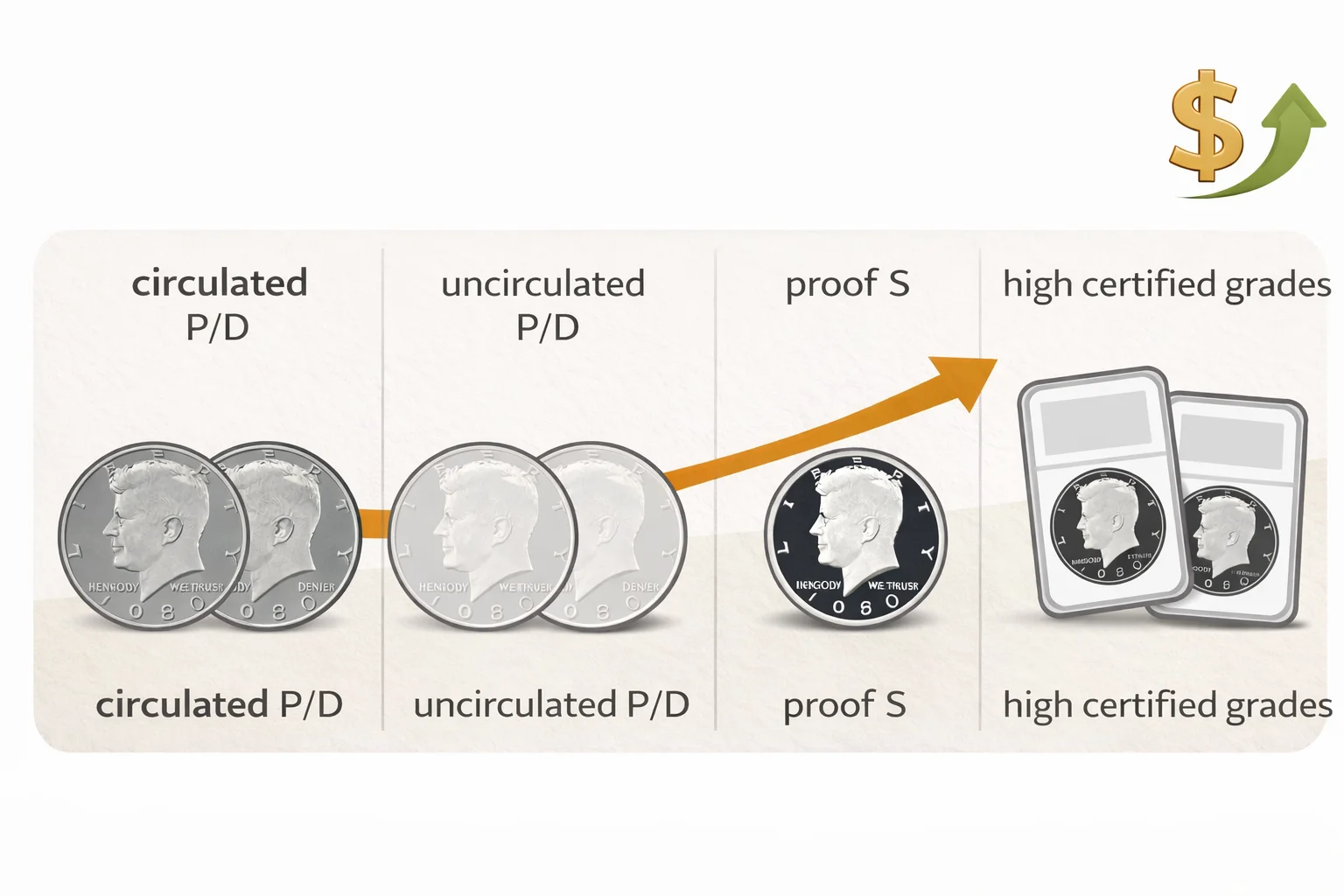
For this date, condition matters more than the year itself. A worn 1980-P is just a cheap half dollar. A lower-end Mint State coin is still modest. A strong MS67 piece is a different market item. That same rule applies to the Denver issue. The date stays common. The better coins do not.
The market ladder is simple:
- Circulated pieces stay low
- Ordinary uncirculated pieces carry a small premium
- Gem coins draw more attention
- Top certified grades move into a much thinner market
This is why a common-date half dollar can still surprise collectors. The surprise does not come from mintage. It comes from the small number of coins that remain truly clean at the top end.
What to Look For on Business Strikes
Business strikes should not be judged by grade label alone. Surface quality matters. Marks on Kennedy’s cheek matter. Open fields matter. Luster matters. The coin can be technically uncirculated and still look average. That is normal for modern clad material. It is also why some pieces sell for a few dollars while better certified pieces move far higher.
A strong 1980 business strike usually has:
- Fewer marks on the cheek
- Cleaner fields
- More even luster
- Better overall balance
- A fresher look than average pieces
The strike itself is not the only issue. Preservation is the bigger one. Many 1980 halves exist. Fewer survive with the look that advanced collectors want.
The 1980-S Proof as a Separate Market Category
The proof is a different product. It was made for collectors, not circulation. The finish is different. The handling was different. The market is different. A proof half dollar should not be compared to a business strike by mintage alone. Its role in the series is not the same.
The 1980-S proof remains affordable in most grades because collector survival is high. Many coins stayed in the original sets. Many remained protected from wear. That keeps the supply healthy. The premium appears only when the proof reaches top quality. Normal proof examples are collector coins, not condition rarities.
Value by Grade and Type
The price structure makes the split clear. NGC places circulated 1980-P and 1980-D pieces at around $0.60 to $0.75. Ordinary uncirculated examples are about $3.62 and up for all three main issues.
After that, the market separates by grade and format. This is where a coin appraisal app free can get an estimated reference market point, which can be considered as a baseline. What is more, the Coin ID Scanner app can help store coins, confirm mint marks, review specs, and keep a simple reference file.
But grade quality still has to be judged by the coin itself.
| Type | Circulated range | Typical uncirculated level | Higher-end certified examples |
| 1980-P | about $0.60 to $0.75 | about $3.62+ | MS67 around $79 to $84; MS67+ reached $2,280 |
| 1980-D | about $0.60 to $0.75 | about $3.62+ | sold from low levels to $608 in MS67; auction record $4,935 in MS68 |
| 1980-S Proof | not a circulation coin | about $3.62+ | GreatCollections sales from $6 to $298 in PF65 to PF70 |
May change, check current values.
The table shows the core pattern. The lower market is quiet. The upper market is selective. The proof stays stable until top grade. The business strikes stay cheap until true quality appears. That is why this coin works better as a condition article than a simple date article.
Who Should Collect the 1980 Half Dollar
The 1980 half dollar suits several kinds of collectors. This half-dollar suits a date-and-mint Kennedy set. It works for proof set collectors. It also works for collectors who like condition coins and want a modern issue that can still separate sharply at the top.
It is also a useful teaching coin. The date is common enough to study without much cost. The better examples are strong enough to show how modern markets actually work. That makes the coin practical. It is not a trophy date. It is a good test of selection.
Frequently Asked Questions
Is the 1980 Kennedy half-dollar rare?
No. The date is common by mintage. Most examples are easy to find. The scarcity appears only in higher certified grades.
Is the 1980-P more important than the 1980-D?
It is more memorable because 1980 was the first year the Philadelphia half dollar carried the P mint mark. That detail adds collector interest. It does not make the coin rare by itself.
Are 1980 half dollars silver?
No. The regular 1980 P, D, and S proof issues are clad coins with a copper core and nickel outer layers.
Is the 1980-S proof a better buy than a business strike?
That depends on the goal. The proof is easier to buy in nice condition. The business strikes offer more room for a condition premium at the top end.
At what level does the market start to care more?
For the business strikes, the real separation begins in the better Mint State range and becomes much stronger by MS67.
Are errors the main reason to collect this date?
No. The main reason is series collecting, proof collecting, and condition-based buying.
Conclusion
The 1980 Kennedy half dollar is common. The market is still selective. That is the whole point of the date. In circulated form, it is a low-cost coin. In ordinary, uncirculated form, it is still modest. In strong certified grades, especially for the business strikes, it becomes a different coin in a different market. This is why the coin remains useful to collectors.